The question came quietly. But it carried the weight of a forest.
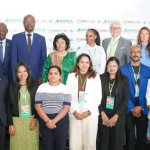
During the Africa Forward Youth and Innovation Day 2026 at the University of Nairobi early last month, Dr. Consolata Mwimali, a lecturer of International relations and diplomacy at Riara University and a native of Ileho in Kakemega county, raised a concern that cut through the optimism of a day devoted to young people, innovation and conservation.
She had listened to presentations about research and conservation around Kakamega Forest. Then she asked a question that was difficult to ignore.
What about the young people living around the forest?
Dr. Mwimali said the picture on the ground, particularly on what she called the Ileho side of the forest, was troubling.
“Actually, the youth are not sensitized towards conserving the forest,” she said. “In fact, it is the youth who are destroying the forest by burning charcoal, by cutting down trees for timber, and doing all sorts of things in the forest.”
She was not speaking about a place she knew from a map. “That’s my home,” she said.
Her prescription was equally direct.
“If you can just go to that place and sensitize the youth,” she urged. Better still, she suggested, the programme should recruit young people from the communities themselves, who could then reach others “in fact, in their vernacular.”
It was a serious challenge to any conservation programme working around Kakamega forest. It was also the kind of question that deserved to be tested beyond the conference room.
I had attended the conference as a climate reporter and when I returned to Kakamega town I decided to verify Dr. Mwimali’s concern. So I went looking.
My journey took me to Lianungo village in Mahiakalo ward, one of the communities around Kakamega Forest. There, I met Victor Mukabwa.
Victor lives close to the forest. He grew up around it and identifies himself as a member of the Isukha community, one of the communities surrounding Kakamega forest. His relationship with the forest is not academic. It is personal.
“I have been brought up here since childhood,” he told me.
But Victor is also part of a different story unfolding around the forest. He is among the young people who have received training through the Wangari Maathai Foundation.
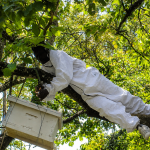
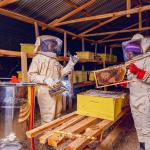
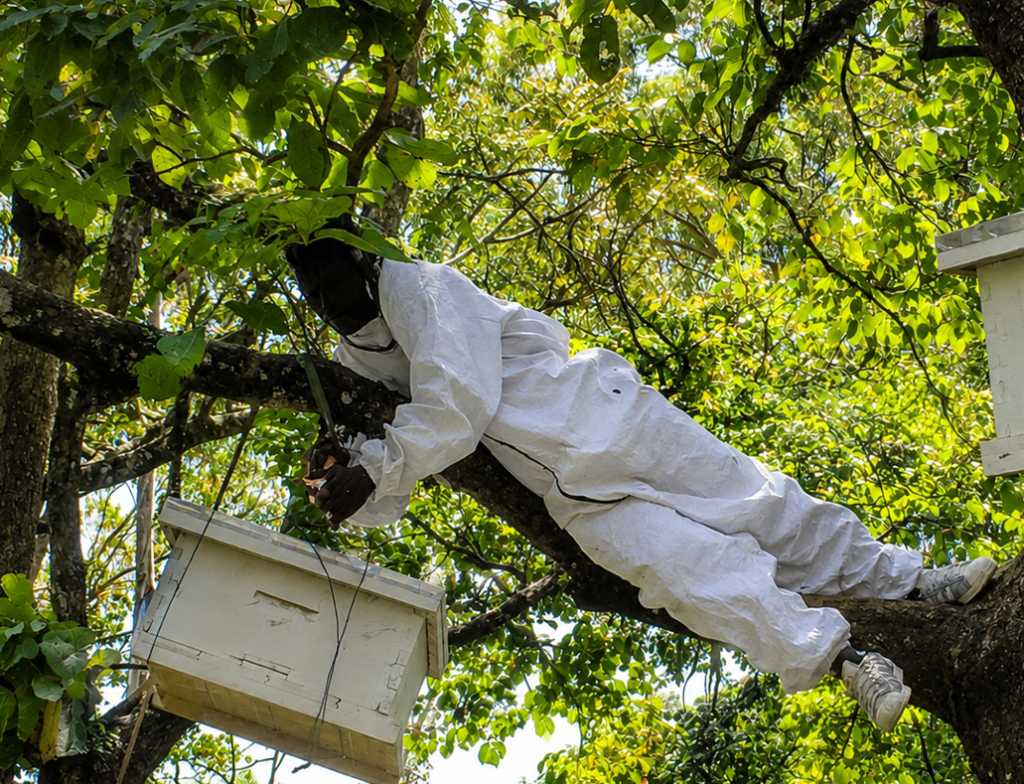
The training has covered forest conservation, tree planting and the restoration of areas where trees have disappeared. More recently, Victor and other young people have been introduced to beekeeping and honey production. The training, he said, comes without a fee.
“We receive this training completely free of charge,” Victor said.
And for him, the significance goes beyond learning how to protect trees. He sees the possibility of earning a living from the skills acquired.
“I think going forward, we will even be able to use this training to get capital and sustain ourselves in life,” he said.
That is an important distinction. Conservation is easier to defend when it is not presented simply as a restriction on what people can do with the land and resources around them. It becomes more persuasive when young people can see an opportunity in protecting what they have.
That is also the philosophy Agnes Naitalei of the Wangari Maathai Foundation described at the Nairobi event. For Agnes, conservation cannot survive on protection alone.
“It’s not through just protecting forests, but empowering communities to protect forests,” she said.
Her argument begins with a simple chain: A visitor comes to Kakamega forest and leaves with a better understanding of its value. An eco-guide earns from ecotourism and demonstrates that a healthy ecosystem can generate income for the local community. A child learns about nature early and grows up seeing conservation not as an imposed rule, but as part of his or her heritage.
“This is how conservation becomes sustainable,” Agnes said.
The foundation's work, she suggested, is therefore about building more than trained guides.
“We are building a generation of conservation leaders,” she said — young people who can see biodiversity as an opportunity and conservation as something that can be exciting.
Technology, science and practical experience, she believes, can change the way young people relate to conservation.
That idea is reflected in the story of Cheryl Echesa.
Cheryl grew up at Isecheno in Shinyalu along the edges of Kakamega Forest and was introduced to conservation as a child through the Kakamega Environmental Education Programme. The lesson stayed with her. She eventually pursued a bachelor’s degree in Conservation Biology at the Kenyatta University.
Then, when the Wangari Maathai Foundation began its work, she found herself returning to the same communities, this time helping other children understand why the forest matters.
“Some of us started working with them for teaching the other kids why we conserve the environment,” she said.
Today, the work includes school tree nurseries and agro-based programmes. For Cheryl, the larger objective is to help young people build livelihoods that do not depend on exploiting the forest.
“The importance is just to build an economy that youth can benefit from,” she said, “so that they do not then go into looking for forest resources.”
Her story offers a powerful counterpoint to the concern raised by Dr. Mwimali. But it does not erase it. One young person's experience cannot tell us what every young person around the forest believes or does.
What it does show is that a different model is possible. A model in which young people are not simply warned against destroying the forest, but are equipped with knowledge and skills that make conservation meaningful.
And the reason that knowledge matters becomes clearer when one listens to David Omurai, a trained ecologist and WMF ecoguide.
“Kakamega Forest is not merely a green patch on a map,” David argued. He described it as the only remnant of the Guineo-Congolian rainforest in Kenya and spoke of the extraordinary diversity found within it.
He cited 590 butterfly species, including 12 he described as endemic to the forest. He spoke of seven species of primates and 262 species of bees like an expert who has spent decades studying and living right at the heart of Kakamega forest.
“It's actually a living museum,” David said.
That phrase lingers. Because a museum is valuable partly because people understand what they are looking at. The same may be true of a forest. If young people understand what lives inside it, what it provides and what it means to their communities, they may be more likely to defend it.
This brings the story back to Dr. Mwimali's question. She did not simply ask WMF to talk to young people. She proposed something more fundamental: bring the young people from the communities into the conservation effort itself. Let them become messengers to their peers. Let them speak in the language of the community.
Victor's experience suggests that Wangari Maathai Foundation had already begun the process a long time ago, Cheryl's journey shows what sustained conservation education can produce over time, Agnes's vision explains why WMF is investing in the approach while David's account reminds us what is at stake.
But Kakamega's challenge is bigger than any single organisation. Training programmes cannot reach everyone at once. Livelihood pressures remain real. Neither a lecture nor a ranger's warning can, by itself, resolve the economic pressures that drive people towards forest resources.
The harder task is to make conservation belong to the people who live beside the forest. Perhaps that is the real significance of the question raised in Nairobi.
The future of Kakamega Forest may not depend only on how effectively it is guarded. It may depend on how many young people come to see themselves as its guardians. Agnes ended her presentation with a familiar conservation wisdom: “In the end, we conserve only what we love, we love only what we understand.”
For Kakamega, the work now is to make sure that the young people living around the forest have the opportunity to understand it. And perhaps, in doing so, to discover that protecting the forest is not only about saving something from their past. It may also be about securing something for their future.